Buy leonida-laconico.eu ?
We are moving the project
leonida-laconico.eu .
Are you interested in purchasing the domain
leonida-laconico.eu ?
domain@kv-gmbh.de · 0541-91531010
Buy leonida-laconico.eu ?
What are microscopes?
Microscopes are scientific instruments used to magnify and observe tiny objects that are not visible to the naked eye. They work by using lenses to focus light on the specimen, allowing for detailed examination of its structure and composition. Microscopes are commonly used in fields such as biology, medicine, chemistry, and materials science to study cells, microorganisms, crystals, and other small objects. There are different types of microscopes, including optical microscopes, electron microscopes, and scanning probe microscopes, each with its own specific capabilities and applications. **
What are the advantages and disadvantages of electron microscopes and light microscopes?
Electron microscopes have the advantage of higher resolution, allowing for the visualization of smaller structures such as individual molecules. They also have a greater magnification power compared to light microscopes. However, electron microscopes are more expensive, require specialized training to operate, and samples need to be placed in a vacuum, which can alter their natural state. On the other hand, light microscopes are more affordable, easier to use, and samples can be observed in their natural state without the need for special preparation. However, they have lower resolution and magnification capabilities compared to electron microscopes, limiting the ability to visualize very small structures. **

Similar search terms for Microscopes
Top-Angebote
Products related to Microscopes:
-
Victorinox Swiss Army Knife Spartan BlackWhen you think of a Swiss Army Knife, the iconic Officer's knife likely comes to mind. The legend lives on with the Victorinox Swiss Army Knife Spartan Black pocket knife. This is the original pocket knife that began it all, helping people around the world accomplish their tasks. No matter where your everyday adventures lead you, the Spartan is ready for the challenge. Tools: Blade, large / Blade, small / Bottle opener / Can opener / Corkscrew / Keyring / Reamer, punch and sewing awl / Screwdriver 3mm / Screwdriver 6mm / Toothpick / Tweezers / Wire Stripper Dimensions: 1.4(H) x 9.1(L) x 2.6(W) cm. Weight: 0.059kg. The Victorinox Swiss Army Knife Spartan Black is covered by a Victorinox lifetime warranty. Knives are not for sale to persons under the age of 18. - all knives and bladed products are delivered by Age Verified Delivery (AVD). The carrier may request proof of age in order to deliver your parcel. If proof of age is not available, or the recipient is underage, the carrier will refuse to deliver.26,95 £*Shipping: 3,50 £Secure redirect to the provider
-
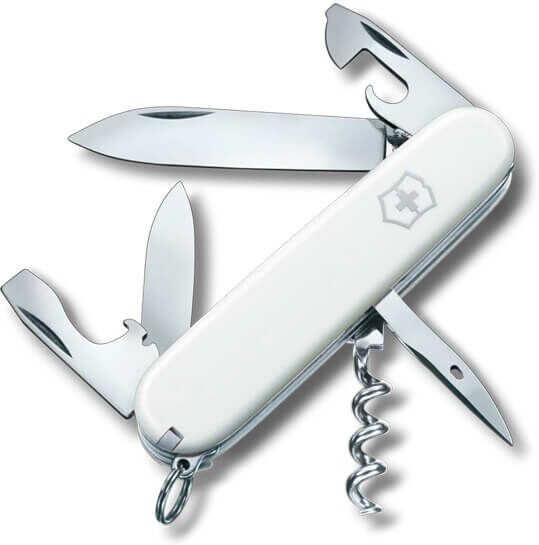
Victorinox Swiss Army Knife Spartan WhiteWhen you think of a Swiss Army Knife, the iconic Officer's knife likely comes to mind. The legend lives on with the Victorinox Swiss Army Knife Spartan White pocket knife. This is the original pocket knife that began it all, helping people around the world accomplish their tasks. No matter where your everyday adventures lead you, the Spartan is ready for the challenge. Tools: Blade, large / Blade, small / Bottle opener / Can opener / Corkscrew / Keyring / Reamer, punch and sewing awl / Screwdriver 3mm / Screwdriver 6mm / Toothpick / Tweezers / Wire Stripper Dimensions: 1.4(H) x 9.1(L) x 2.6(W) cm. Weight: 0.059kg. The Victorinox Swiss Army Knife Spartan White is covered by a Victorinox lifetime warranty. Knives are not for sale to persons under the age of 18. - all knives and bladed products are delivered by Age Verified Delivery (AVD). The carrier may request proof of age in order to deliver your parcel. If proof of age is not available, or the recipient is underage, the carrier will refuse to deliver.26,95 £*Shipping: 3,50 £Secure redirect to the provider
-
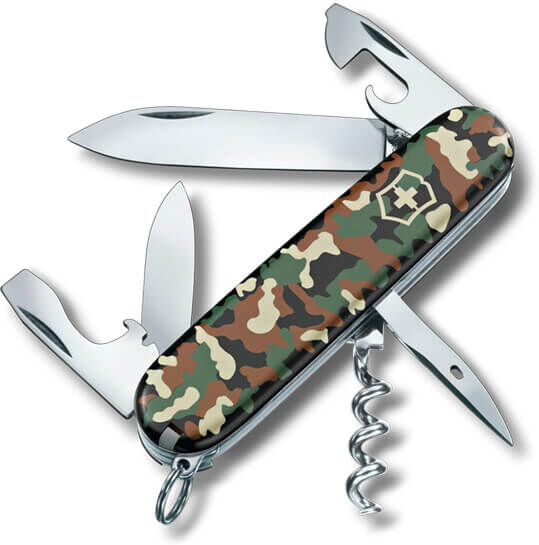
Victorinox Swiss Army Knife Spartan CamouflageWhen you think of a Swiss Army Knife, the iconic Officer's knife likely comes to mind. The legend lives on with the Victorinox Swiss Army Knife Spartan Camouflage pocket knife. This is the original pocket knife that began it all, helping people around the world accomplish their tasks. No matter where your everyday adventures lead you, the Spartan is ready for the challenge. Tools: Blade, large / Blade, small / Bottle opener / Can opener / Corkscrew / Keyring / Reamer, punch and sewing awl / Screwdriver 3mm / Screwdriver 6mm / Toothpick / Tweezers / Wire Stripper Dimensions: 1.4(H) x 9.1(L) x 2.6(W) cm. Weight: 0.059kg. The Victorinox Swiss Army Knife Spartan Camouflage is covered by a Victorinox lifetime warranty. Knives are not for sale to persons under the age of 18. - all knives and bladed products are delivered by Age Verified Delivery (AVD). The carrier may request proof of age in order to deliver your parcel. If proof of age is not available, or the recipient is underage, the carrier will refuse to deliver.30,95 £*Shipping: 3,50 £Secure redirect to the provider


-
Why do biologists use light microscopes, even though electron microscopes offer much higher magnification?
Biologists use light microscopes because they are more versatile and can be used to observe living organisms in their natural state. Light microscopes also allow for the observation of a wider range of samples, including transparent or unstained specimens. Additionally, light microscopes are more affordable and easier to use compared to electron microscopes, making them more accessible to a wider range of researchers. **
-
How many microscopes for bacteria are there?
There are several types of microscopes that can be used to observe bacteria, including light microscopes, electron microscopes, and fluorescence microscopes. Each type of microscope has its own advantages and limitations for studying bacteria. For example, light microscopes are commonly used for observing live bacteria, while electron microscopes provide higher resolution images but require specialized sample preparation. Overall, there are multiple options for studying bacteria using microscopy, each with its own unique capabilities. **
-
What is the field of application for microscopes?
Microscopes are used in a wide range of fields including biology, medicine, chemistry, geology, and material science. In biology and medicine, microscopes are used to study cells, tissues, and microorganisms. In chemistry, they are used to analyze the structure of molecules and materials. In geology, microscopes are used to study minerals and rocks, while in material science, they are used to examine the structure and properties of various materials. Overall, microscopes are essential tools for studying and understanding the microscopic world. **
-
Do microscopes and telescopes have the same principle?
Microscopes and telescopes operate on similar principles of using lenses to magnify objects, but they are designed for different purposes. Microscopes are used to magnify small objects such as cells and microorganisms, while telescopes are used to observe distant objects in space. Both instruments rely on the manipulation of light to produce magnified images, but their specific designs and functions are tailored to their intended use. **


In which professions do people work exclusively with microscopes?
People who work exclusively with microscopes can be found in professions such as microbiology, histology, pathology, and certain fields of chemistry and materials science. Microbiologists study microorganisms, histologists examine the microscopic structure of tissues, pathologists analyze tissue samples for diseases, and scientists in chemistry and materials science use microscopes to study the properties and structures of materials at the microscopic level. These professionals rely on microscopes to conduct their research and analysis, making them an essential tool in their work. **
What are the advantages and disadvantages of different types of microscopes?
The advantages of light microscopes include their affordability, ease of use, and ability to observe living organisms. However, they have limited magnification and resolution compared to electron microscopes. Electron microscopes, on the other hand, offer much higher magnification and resolution, allowing for the observation of smaller structures. However, they are expensive, require specialized training, and can only be used to observe non-living specimens. Scanning probe microscopes have the advantage of being able to observe surfaces at the atomic level, but they are also expensive and require a high level of expertise to operate. **
Top-Angebote
Products related to Microscopes:
-
Bronzhaus Bronze Sculpture Brave Medieval Knight Warrior Art Deco Original Marble FigurineCondition: This sculpture is in perfect condition. Bronze Dimensions with Marble Base: Height 23 inches x Width 12 inches Marble Dimensions: 11 inches X 5 inches.465,49 $*Shipping: 0,00 $Secure redirect to the provider
-
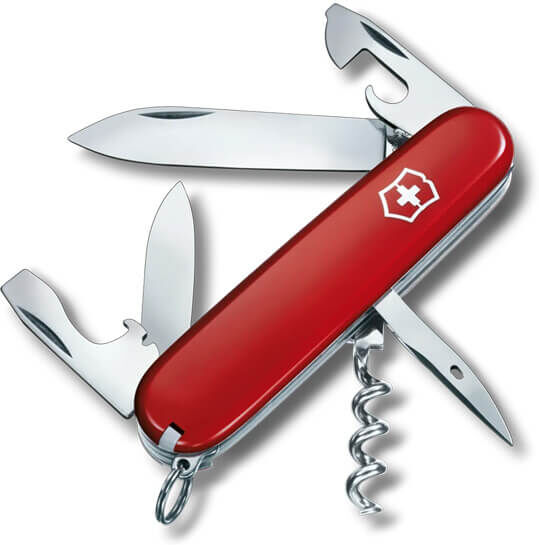
Victorinox Swiss Army Knife Spartan RedWhen you think of a Swiss Army Knife, the iconic Officer's knife likely comes to mind. The legend lives on with the Victorinox Swiss Army Knife Spartan pocket knife. This is the original pocket knife that began it all, helping people around the world accomplish their tasks. No matter where your everyday adventures lead you, the Spartan is ready for the challenge. Tools: Blade, large / Blade, small / Bottle opener / Can opener / Corkscrew / Keyring / Reamer, punch and sewing awl / Screwdriver 3mm / Screwdriver 6mm / Toothpick / Tweezers / Wire Stripper Dimensions: 1.4(H) x 9.1(L) x 2.6(W) cm. Weight: 0.059kg. The Victorinox Swiss Army Knife Spartan is covered by a Victorinox lifetime warranty. Knives are not for sale to persons under the age of 18. - all knives and bladed products are delivered by Age Verified Delivery (AVD). The carrier may request proof of age in order to deliver your parcel. If proof of age is not available, or the recipient is underage, the carrier will refuse to deliver.26,95 £*Shipping: 3,50 £Secure redirect to the provider
-
Victorinox Swiss Army Knife Spartan BlackWhen you think of a Swiss Army Knife, the iconic Officer's knife likely comes to mind. The legend lives on with the Victorinox Swiss Army Knife Spartan Black pocket knife. This is the original pocket knife that began it all, helping people around the world accomplish their tasks. No matter where your everyday adventures lead you, the Spartan is ready for the challenge. Tools: Blade, large / Blade, small / Bottle opener / Can opener / Corkscrew / Keyring / Reamer, punch and sewing awl / Screwdriver 3mm / Screwdriver 6mm / Toothpick / Tweezers / Wire Stripper Dimensions: 1.4(H) x 9.1(L) x 2.6(W) cm. Weight: 0.059kg. The Victorinox Swiss Army Knife Spartan Black is covered by a Victorinox lifetime warranty. Knives are not for sale to persons under the age of 18. - all knives and bladed products are delivered by Age Verified Delivery (AVD). The carrier may request proof of age in order to deliver your parcel. If proof of age is not available, or the recipient is underage, the carrier will refuse to deliver.26,95 £*Shipping: 3,50 £Secure redirect to the provider
-
Victorinox Swiss Army Knife Spartan WhiteWhen you think of a Swiss Army Knife, the iconic Officer's knife likely comes to mind. The legend lives on with the Victorinox Swiss Army Knife Spartan White pocket knife. This is the original pocket knife that began it all, helping people around the world accomplish their tasks. No matter where your everyday adventures lead you, the Spartan is ready for the challenge. Tools: Blade, large / Blade, small / Bottle opener / Can opener / Corkscrew / Keyring / Reamer, punch and sewing awl / Screwdriver 3mm / Screwdriver 6mm / Toothpick / Tweezers / Wire Stripper Dimensions: 1.4(H) x 9.1(L) x 2.6(W) cm. Weight: 0.059kg. The Victorinox Swiss Army Knife Spartan White is covered by a Victorinox lifetime warranty. Knives are not for sale to persons under the age of 18. - all knives and bladed products are delivered by Age Verified Delivery (AVD). The carrier may request proof of age in order to deliver your parcel. If proof of age is not available, or the recipient is underage, the carrier will refuse to deliver.26,95 £*Shipping: 3,50 £Secure redirect to the provider
-
What are microscopes?
Microscopes are scientific instruments used to magnify and observe tiny objects that are not visible to the naked eye. They work by using lenses to focus light on the specimen, allowing for detailed examination of its structure and composition. Microscopes are commonly used in fields such as biology, medicine, chemistry, and materials science to study cells, microorganisms, crystals, and other small objects. There are different types of microscopes, including optical microscopes, electron microscopes, and scanning probe microscopes, each with its own specific capabilities and applications. **
-
What are the advantages and disadvantages of electron microscopes and light microscopes?
Electron microscopes have the advantage of higher resolution, allowing for the visualization of smaller structures such as individual molecules. They also have a greater magnification power compared to light microscopes. However, electron microscopes are more expensive, require specialized training to operate, and samples need to be placed in a vacuum, which can alter their natural state. On the other hand, light microscopes are more affordable, easier to use, and samples can be observed in their natural state without the need for special preparation. However, they have lower resolution and magnification capabilities compared to electron microscopes, limiting the ability to visualize very small structures. **
-
Why do biologists use light microscopes, even though electron microscopes offer much higher magnification?
Biologists use light microscopes because they are more versatile and can be used to observe living organisms in their natural state. Light microscopes also allow for the observation of a wider range of samples, including transparent or unstained specimens. Additionally, light microscopes are more affordable and easier to use compared to electron microscopes, making them more accessible to a wider range of researchers. **
-
How many microscopes for bacteria are there?
There are several types of microscopes that can be used to observe bacteria, including light microscopes, electron microscopes, and fluorescence microscopes. Each type of microscope has its own advantages and limitations for studying bacteria. For example, light microscopes are commonly used for observing live bacteria, while electron microscopes provide higher resolution images but require specialized sample preparation. Overall, there are multiple options for studying bacteria using microscopy, each with its own unique capabilities. **
Similar search terms for Microscopes
-
Victorinox Swiss Army Knife Spartan CamouflageWhen you think of a Swiss Army Knife, the iconic Officer's knife likely comes to mind. The legend lives on with the Victorinox Swiss Army Knife Spartan Camouflage pocket knife. This is the original pocket knife that began it all, helping people around the world accomplish their tasks. No matter where your everyday adventures lead you, the Spartan is ready for the challenge. Tools: Blade, large / Blade, small / Bottle opener / Can opener / Corkscrew / Keyring / Reamer, punch and sewing awl / Screwdriver 3mm / Screwdriver 6mm / Toothpick / Tweezers / Wire Stripper Dimensions: 1.4(H) x 9.1(L) x 2.6(W) cm. Weight: 0.059kg. The Victorinox Swiss Army Knife Spartan Camouflage is covered by a Victorinox lifetime warranty. Knives are not for sale to persons under the age of 18. - all knives and bladed products are delivered by Age Verified Delivery (AVD). The carrier may request proof of age in order to deliver your parcel. If proof of age is not available, or the recipient is underage, the carrier will refuse to deliver.30,95 £*Shipping: 3,50 £Secure redirect to the provider
-
DC Comics DC Justice League Heroic Holiday Helpers Silk Touch Throw Blanket"Indulge in ultimate comfort and softness with Warner Bros. DC Justice League ""Heroic Holiday Helpers"" Silk Touch Blanket. Made from 100% polyester, this blanket is silky smooth to the touch and provides the perfect amount of warmth."42,99 $*Shipping: 0,00 $Secure redirect to the provider
-
Kiss imPRESS The No Glue Mani false nails self-adhesive Heroic 30 pcKISS imPRESS The No Glue Mani, 30 pc, Gel and Acrylic Nails for Women, Are you a fan of precise yet easy manicures? Then you'll love the ease of application of KISS imPRESS The No Glue Mani false nails. They allow you to create a beautiful manicure like a professional very quickly and in the comfort of your home. They will give your hands a sophisticated look that will be suitable for many different occasions. In addition, the manicure will last in perfect condition longer than one created with the help of conventional nail polish. Just glue on the nails according to size and you're done: a salon-like manicure! Characteristics: for repeated use no glue is needed for their application, they have their own self-adhesive layer thanks to its excellent adhesion, it lasts on nails for a very long time allow you to create an unmissable salon-like manicure in minutes gel manicure effect How to use: Follow the instructions for use included. Press or carefully remove the cuticle with manicure scissors or clippers. Apply a drop of glue to the artificial nails, put them on your actual nails and press them for at least 30 seconds.8,30 £*Shipping: 3,99 £Secure redirect to the provider
-
What is the field of application for microscopes?
Microscopes are used in a wide range of fields including biology, medicine, chemistry, geology, and material science. In biology and medicine, microscopes are used to study cells, tissues, and microorganisms. In chemistry, they are used to analyze the structure of molecules and materials. In geology, microscopes are used to study minerals and rocks, while in material science, they are used to examine the structure and properties of various materials. Overall, microscopes are essential tools for studying and understanding the microscopic world. **
-
Do microscopes and telescopes have the same principle?
Microscopes and telescopes operate on similar principles of using lenses to magnify objects, but they are designed for different purposes. Microscopes are used to magnify small objects such as cells and microorganisms, while telescopes are used to observe distant objects in space. Both instruments rely on the manipulation of light to produce magnified images, but their specific designs and functions are tailored to their intended use. **
-
In which professions do people work exclusively with microscopes?
People who work exclusively with microscopes can be found in professions such as microbiology, histology, pathology, and certain fields of chemistry and materials science. Microbiologists study microorganisms, histologists examine the microscopic structure of tissues, pathologists analyze tissue samples for diseases, and scientists in chemistry and materials science use microscopes to study the properties and structures of materials at the microscopic level. These professionals rely on microscopes to conduct their research and analysis, making them an essential tool in their work. **
-
What are the advantages and disadvantages of different types of microscopes?
The advantages of light microscopes include their affordability, ease of use, and ability to observe living organisms. However, they have limited magnification and resolution compared to electron microscopes. Electron microscopes, on the other hand, offer much higher magnification and resolution, allowing for the observation of smaller structures. However, they are expensive, require specialized training, and can only be used to observe non-living specimens. Scanning probe microscopes have the advantage of being able to observe surfaces at the atomic level, but they are also expensive and require a high level of expertise to operate. **
* All prices are inclusive of VAT and, if applicable, plus shipping costs. The offer information is based on the details provided by the respective shop and is updated through automated processes. Real-time updates do not occur, so deviations can occur in individual cases. ** Note: Parts of this content were created by AI.